
What is the Webster Technique?
Dr. Jennifer Myers, a Plano Chiropractor, Explains
The Webster Technique is a specific chiropractic adjustment of the sacrum and pelvis used during pregnancy to reduce nervous system stress and restore balance to the pelvic muscles and ligaments.
I’m Dr. Jennifer Myers, a Webster-certified chiropractor through the International Chiropractic Pediatric Association (ICPA), and I’ve used this technique with expecting moms across Plano, Frisco, Carrollton, Addison, and North Dallas. It’s one of the most rewarding parts of what we do at Zone Chiropractic Clinic.
This guide explains what the Webster Technique is, what it actually does (and what it doesn’t), what an appointment feels like, when to start, how often to come in, and what the research says. If you’re researching prenatal chiropractic care in Plano, TX, this is for you.
The Short Answer
The Webster Technique is a gentle, specific chiropractic adjustment of the sacrum (the triangular bone at the base of the spine) and the supporting pelvic structures. It was developed in the 1980s by Dr. Larry Webster, DC, who founded the International Chiropractic Pediatric Association.
Designed for pregnant patients, though the underlying biomechanical principles apply to anyone with sacral imbalance. The goal is straightforward: restore proper alignment and function to the pelvis so the body can do what it’s designed to do.
It removes biomechanical stress from the mother’s pelvis. When the pelvis is balanced, ligaments don't pull unevenly on the uterus, the sacroiliac joints move as they should, and the nervous system is free of interference in that region. What the body does with that balance is up to the body.
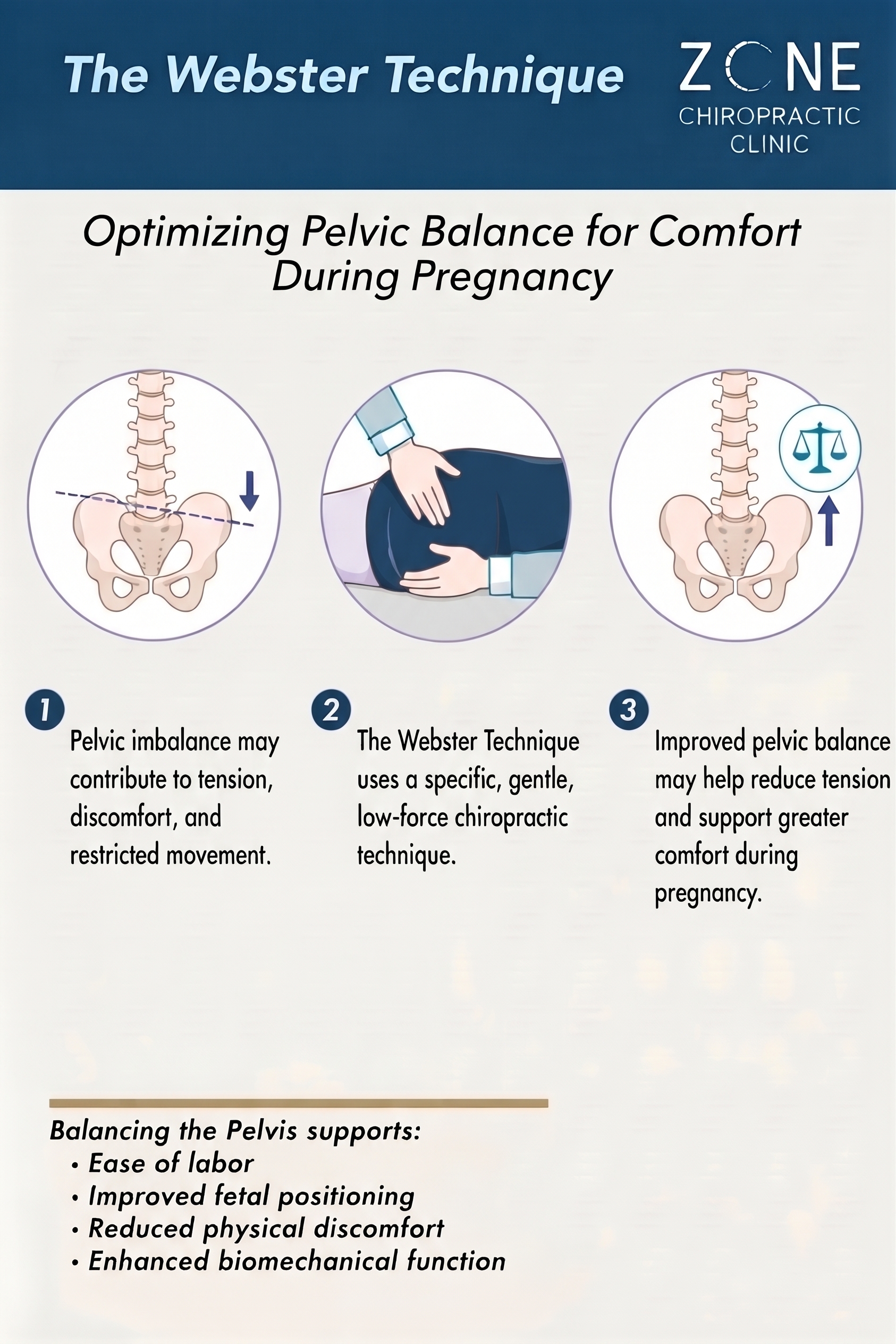
How does the Webster Technique work?
There are three pieces to understand: biomechanics, adjustment, and what the research actually shows.
Biomechanics
During pregnancy, your body produces a hormone called relaxin that loosens ligaments throughout the pelvis to prepare for birth. At the same time, your uterus grows, your center of gravity shifts forward, and the load on your pelvis climbs every week.
The sacroiliac joints, where the sacrum meets the hip bones on either side, can become misaligned or restricted under this kind of load. Chiropractors call this sacral subluxation. When it happens, the round ligaments and other pelvic ligaments that attach to and support the uterus can become unevenly tensioned. The result is biomechanical interference in the pelvis.
Adjustment
When I see a Webster patient, I start with a specific analysis to identify exactly where the sacral imbalance is. I then apply a gentle, low-force adjustment to the sacrum. After the adjustment, I do soft-tissue work on the round ligament area to release the supporting structures. The intended result is restored pelvic balance, reduced ligament tension, and improved nervous system function in the pelvic region.
The whole process is gentle. There is no twisting of the abdomen, no forceful pressure on the belly, and no manipulation of the baby. Webster-certified chiropractors can use specially designed pregnancy tables or cushions that let mom lie comfortably, even in the third trimester.
What the Research Says
The ICPA’s own position, which I share, is that Webster is intended to optimize maternal pelvic function. Not to turn babies.
The technique creates conditions in which the baby is more likely to find optimal position on its own, but no chiropractor can or should guarantee that outcome.
Pregnancy Biomechanics & Pelvic Balance
How pregnancy alters posture, center of gravity, and pelvic stress from early through late pregnancy.
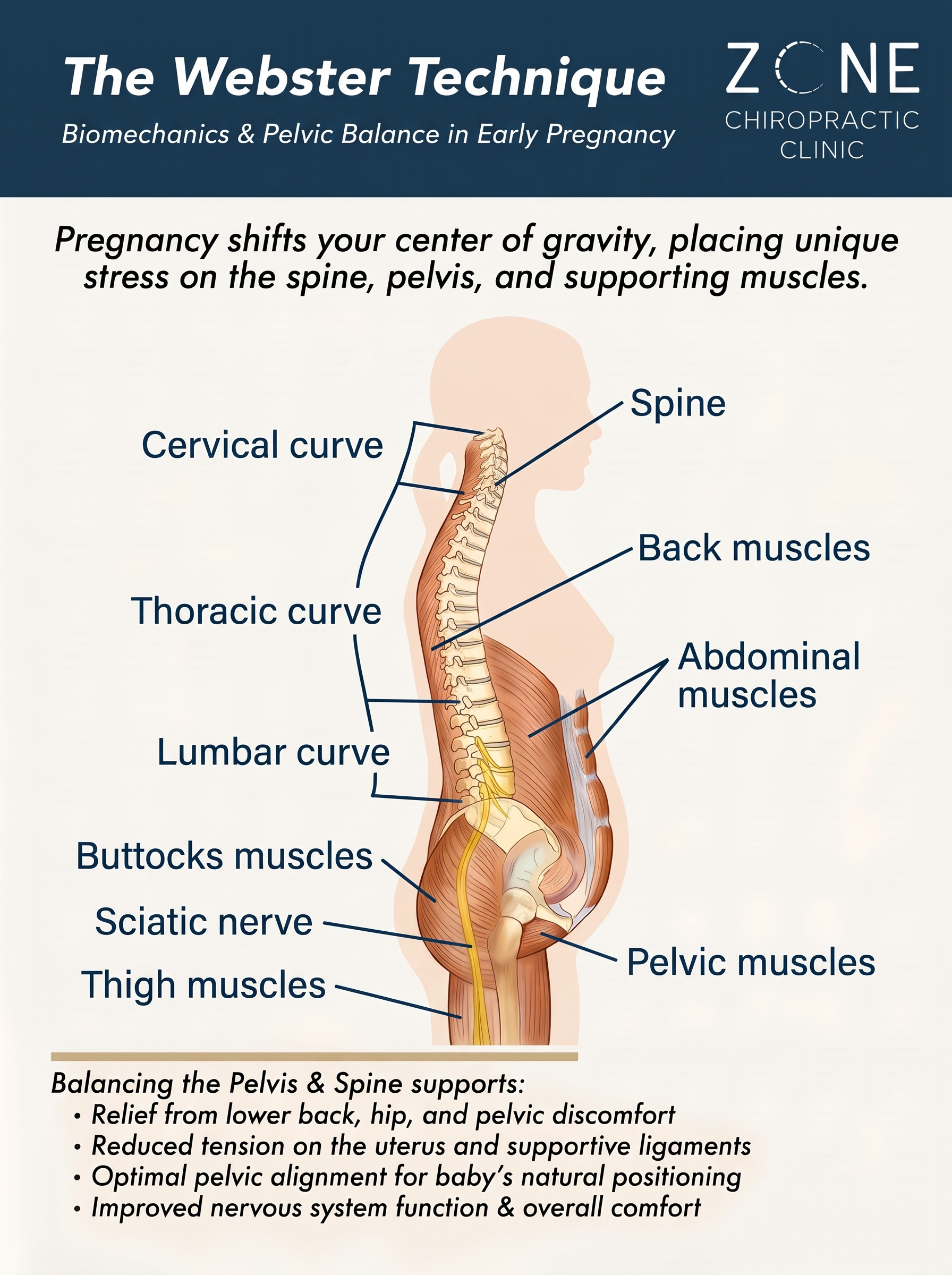
Early Pregnancy Biomechanics
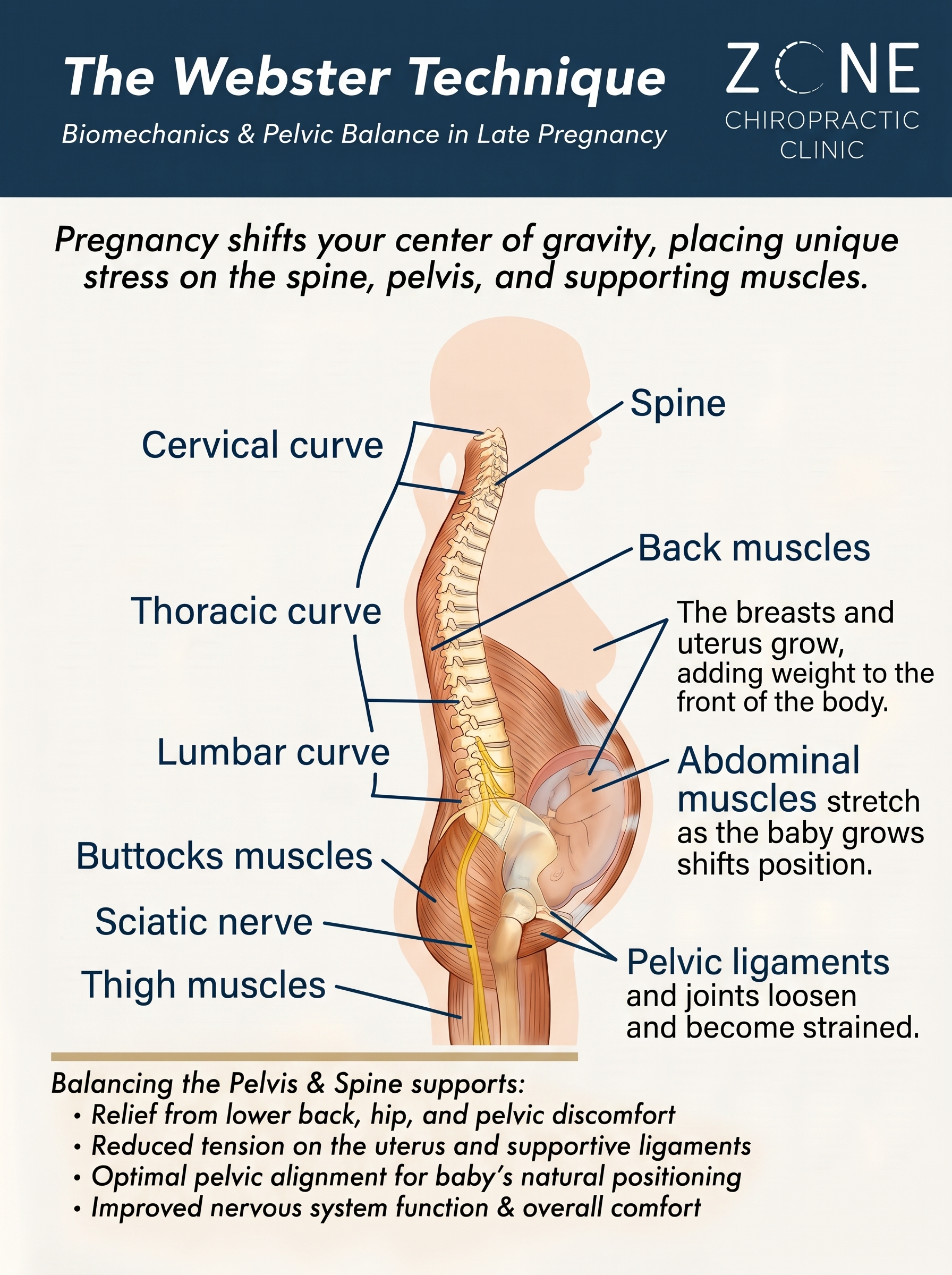
Late Pregnancy Biomechanics
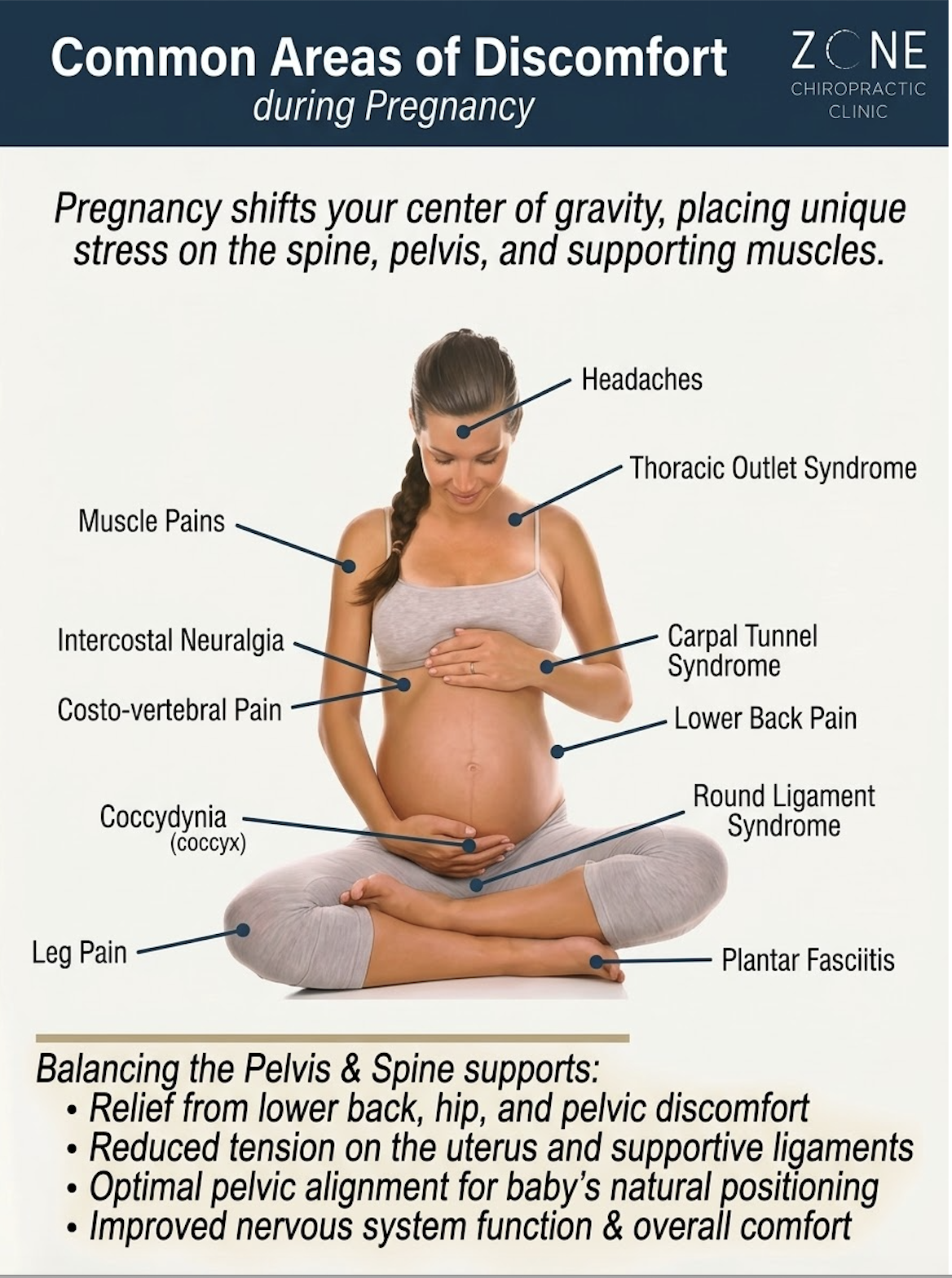
Common Pregnancy Discomfort Areas
Who is the Webster Technique for?
Pregnant women in any trimester who want to support pelvic balance and a more comfortable pregnancy.
Pregnant women experiencing lower back pain, hip pain, or pelvic pain.
Pregnant women with sciatica or round ligament pain.
Pregnant women preparing for labor and delivery who want their pelvis in the best possible biomechanical shape.
The technique can also benefit non-pregnant patients with sacroiliac dysfunction, though its primary use is prenatal.
What to expect at a Webster Technique appointment
Most top articles on the Webster Technique describe it mechanically. They skip the part that matters most to moms: what it actually feels like to walk into our office, get on the table, and receive an adjustment.
Your First Visit
Your first visit at Zone Chiropractic Clinic starts with a detailed health history covering your pregnancy, your due date, your baby’s position if you know it, any concerns or symptoms, and any recommendations from your OB or midwife. After history, I do a postural and pelvic examination. We talk through what I’m seeing, your goals, and what a care plan would look like. Then, if everything points to Webster being a good fit, we move into the first adjustment.
What the Adjustment Feels Like
The adjustment itself is gentle. I apply a low-force, specific pressure to the sacrum at a specific angle. Most patients describe it as a release of pressure rather than a forceful adjustment. After the adjustment, I do soft-tissue work on the round ligament area, which feels like a focused massage. The whole adjustment takes a few minutes.
After the Visit
There’s no downtime. No soreness in most cases. Many patients feel an immediate sense of relief in the lower back or pelvis. I recommend drinking water and moving gently for the rest of the day, but you can go right back to whatever you had planned.
The Webster Technique and breech babies
The Webster Technique is often discussed in connection with breech babies, but it’s important to understand what it does and doesn’t.
A breech baby is one positioned bottom-down or feet-down rather than head-down in the third trimester. Most babies turn head-down on their own by 36 weeks. A smaller percentage remain breech.
A 2002 study published in the Journal of Manipulative and Physiological Therapeutics reported an 82 percent success rate of optimal fetal positioning after Webster Technique care among women whose babies were in breech presentation. That number gets quoted a lot, and it’s worth being honest about its limitations: it was a case series, not a randomized controlled trial, and more recent reviews have called for additional research. The ICPA’s position — which I share — is that Webster is intended to optimize maternal pelvic function, not to turn babies. No Webster-certified provider should ever guarantee a baby will turn.
The Webster Technique can complement standard prenatal care; it does not replace care from an OB-GYN or midwife. If a baby remains breech after approximately 36 weeks, an eligible patient may be offered external cephalic version (ECV)—an obstetric procedure in which a trained clinician applies pressure to the abdomen to try to turn the baby to a head-down position. ECV is typically considered around 36–37 weeks and should be performed in an appropriate obstetric setting with access to urgent cesarean delivery if needed. Webster can be used alongside ECV planning, and some of my patients use both.
The most important conversation you can have if your baby is breech is with your OB or midwife. The Webster Technique can support your prenatal plan. It should never be the only thing you do.
Why Webster certification matters
Not every chiropractor is Webster Certified. The ICPA’s Webster Certification is a post-doctoral training program. It covers prenatal anatomy and physiology, the Webster Technique itself, safety protocols, contraindications, case management, and ongoing education. Re-certification is required to maintain credentials, which means the training stays current.
I’m one of the Webster-certified chiropractors serving the Plano and Dallas area, and I’m always happy to answer questions about whether the technique is right for your situation.
Webster Technique FAQs
You can begin the Webster Technique at any point in pregnancy, though many moms start in the second trimester or as soon as they begin feeling pelvic discomfort. First trimester care is safe and supportive, particularly if you're already experiencing low back pain or sciatica. The second trimester is a great time to establish a baseline of pelvic balance before the heavier loads of the third trimester arrive. There is no week of pregnancy at which Webster becomes unsafe. The earlier you start, the more time we have to support a balanced pelvis through pregnancy changes.
Most patients see their Webster chiropractor weekly or every other week through the second and third trimesters, with frequency adjusted to individual needs. In the first trimester, care is often as-needed, sometimes monthly. In the second trimester, care is often every other week. In the third trimester, weekly care is common, and we may see patients more often as they approach their due date. Every plan is individual. We adjust frequency based on what we find on examination, how you're feeling, and what your birth team is recommending.
Yes, the Webster Technique is considered safe when performed by a Webster-certified chiropractor on a healthy pregnancy. The technique uses low-force, gentle adjustments. It avoids the abdomen entirely. The ICPA's certification requires specific training in safe prenatal adjusting protocols. That said, care may need to pause or be modified. High-risk pregnancies should always be cleared with the OB or midwife first. Active vaginal bleeding, placenta previa, or other high-risk conditions are reasons to wait. If any of those come up during your pregnancy, we coordinate with your medical team before continuing.
The Webster Technique is a specific protocol focused on sacral alignment and pelvic ligament balance, with a defined certification and training pathway through the ICPA. General prenatal chiropractic care may include a wider range of techniques, some of which are not specific to pregnancy. Webster-certified providers can offer both, with prenatal safety protocols built into every adjustment.
No. The Webster Technique is gentle. Most patients describe the adjustment as a release of pressure rather than a forceful manipulation. If you ever feel discomfort during an adjustment, tell your chiropractor immediately.
No. The Webster Technique does not turn breech babies. It works on the mother's pelvis to remove biomechanical interference. Many babies move into a head-down position on their own after a course of Webster care, but that movement is the baby's, not the chiropractor's. No Webster-certified provider should ever guarantee a baby will turn.
No. The Webster Technique isn't designed to induce labor and hasn't been shown to do so. It works on pelvic alignment and ligament balance throughout pregnancy, not on stimulating contractions. If you're past your due date and considering induction options, that's a conversation for your OB or midwife.
Ready to Experience the Webster Technique?
Schedule your prenatal consultation with Dr. Jennifer Myers at Zone Chiropractic Clinic in Plano, TX.
Book an Appointment